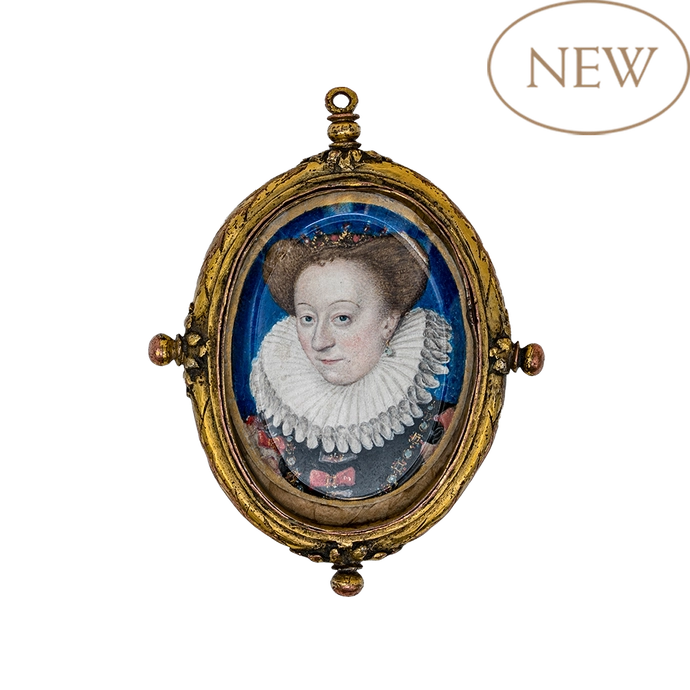


Double-sided Pendant with Portrait Miniature of Françoise de Daillon, Lady of Malicorne
Attributed to the workshop of Benjamin Foulon (c. 1550-1612)
, France, 1575
Double-sided Pendant with Portrait Miniature of Françoise de Daillon, Lady of Malicorne
Attributed to the workshop of Benjamin Foulon (c. 1550-1612)
Description
Double-sided pendant case made of gilt bronze with rounded edging, reed-like adornment and four acanthus foliage ornaments with globule, on top with pendant loop. Engraved on the reverse backplate is the draped figure of Terpsichore playing a lute framed by c-scrolls and fruit garlands. Inserted in the obverse is a miniature portrait in watercolor on vellum showing the bust of a lady in three-quarter profile gazing at the viewer against a bright blue background: She is wearing a black dress with high-necked bodice, red bows and white ruff. Her brown hair parted in the center forms a heart-shaped hairdo. Her jewels are indistinct, but the small crown and jewels appear to be gold with pearls and rubies and in her ear is a drop pearl. The pendant shows signs of wear through age, in particular the gilding on the reverse through rubbing against the textile when worn. The pendant is in good wearable condition.
On the reverse of the portrait, a handwritten note in French: “francoise / de Daillon / portret de madame / de Malicorne / ma tante fet/ an. 1575.” (Portrait of Françoisede Daillon my aunt, made in the year 1575).
Sitter:
The miniature depicts Françoise de Daillon “la Jeune” [not “l’Aînée,” known as “de Matignon”] (c. 1549-after 1619) in 1575, as the note confirms, daughter of Jacques d’Illiers. Jacques d’Illiers was Jacques de Daillon, seigneur de Lude, near Anjou, who married three times and had eight children. The first daughter and the fourth child, Françoise de Daillon “l’Aînée” [de Matignon] was born in 1538 and died between January 1568 and 1569. Thus, she was deceased at the time this portrait was painted. The family was evidently well connected, because she served as a lady-in-waiting to Catherine de Medici, Queen of France (1519-1589). The seventh child, Françoise de Daillon “La Jeune” was born in 1549 and died after 1619. She also held positions at court, as maid-of-honor, first for Elisabeth of Austria (1571-1572), then for Louise of Lorraine (1579). She married on 14 July 1578, to Jean de Chourses, seigneur de Malicorne, who was the Governor of Poitou, captain of an army of fifty men, and chevalier of the order of the King. We have not located any other portraits of either Françoise“la Jeune” or Jean de Chourses. Françoise would have been twenty-six years old when this portrait was painted, three years before her marriage.
For a genealogy of the Daillon family, see
http://racineshistoire.free.fr/LGN/PDF/Daillon.pdf
Reverse:
The image on the reverse is that of Terpsichore, in Greek mythology the muse of lyric poetry and dance, who played the lyre. Music was a way of expressing emotions. In the Renaissance, jewels depicting musical instruments belonged to the language of love (Beatriz Chadour-Sampson, The Power of Love, Jewels, Romance and Eternity, London 2019, p. 51). It may have been painted when her family was looking for a suitor for her (she was already 26 and will get married at 29, which is old for the Renaissance nobility) and then eventually kept within the family and eventually with her future husband. The fact that there is a later inscription from a niece or nephew on the back means that it is perhaps not in its original setting for it would be difficult to re-open a medallion for the sake of writing the identification on the reverse but it is likely a family heirloom, a treasured family jewel. The style and the motif are close to engravings by Étienne Delaune (1518-1583), especially that of La Musique dated before 1573 (London, Victoria and Albert Museum, E. 20-1885). Delaune was a French goldsmith, medalist, engraver, and draughtsman.
Artist:
The miniature painting in this double-sided pendant is in the style of François Clouet (c. 1510-1572), who like his father Jean worked for the French Court and was favored by royalty and nobility. In fact, he painted miniatures of Catherine de Medici who had employed the elder sister Françoise de Daillon de Lude, see: Victoria and Albert Museum, London (inv. no. P.26-1954, c. 1555) and Kunsthistorisches Museum, Vienna (Diana Scarisbrick, Portrait Jewels Opulence & Intimacy from the Medici to the Romanovs, London 2011, pp. 54-55). The standard work on French portrait miniature is now more than a century old (see Louis Dimier, Histoire de la peinture de portrait en France au XVIe siècle: accompagnée d'un catalogue de tous les ouvrages subsistant en ce genre, de crayon, Paris, 1924-26). The many followers of Clouet, working in his style, still need to be fully studied, and they are assessed in a forthcoming doctoral dissertation by Celine Cachaud, PhD candidate, University of Geneva, for whom we thank for her assistance. The present work is included in her catalogue raisonné.
Thanks to Celine Cachaud, we tentatively attribute the present portrait miniature to Benjamin Foulon (c. 1550-1612), who was the nephew and pupil of François Clouet. Ms. Cachaud includes a study of this miniature in the catalogue of her forthcoming dissertation. Foulon appears in 1576-1578 among the “pensionnaires du roy en son Espargne” thus one year after the date of our miniature. Unfortunately, there are no miniatures securely attributed by signature or document to Foulon. Two miniatures of a much later date and uncertain attribution have been sold at Sotheby’s London, the second of Charles de Bourbon, comte de Soissons (1566-1612) from the Pohl-Ströher collection (Sotheby's, December 5th 2019, lot 3). Another miniature in the Uffizi is also attributed to him.
Attributions to Foulon are based on comparisons to his drawings. Compare this drawing of François de Daillon (1570-1619), count de Lude, marquis d’Illiers, and nephew of Françoise de Daillon La Jeune, attributed by Louis Dimier to Benjamin Foulon (fig. 5). Cachaud notes the whiteness of the faces in Foulon’s drawings and the modelling and shading in comparison with the present portrait miniature. She also states “what is fascinating about the piece [our portrait miniature] is that it is quite close to Nicholas Hilliard in spirit. Louis Dimier also mentioned the influence of English portraits in French portraiture by the late 16th century. However, this artwork predates Hilliard’s trip to France by a year, showing a possible influence of the English miniaturist even before he arrived.”
We are grateful to Celine Cachaud and Beatriz Chadour-Sampson and for their expertise.