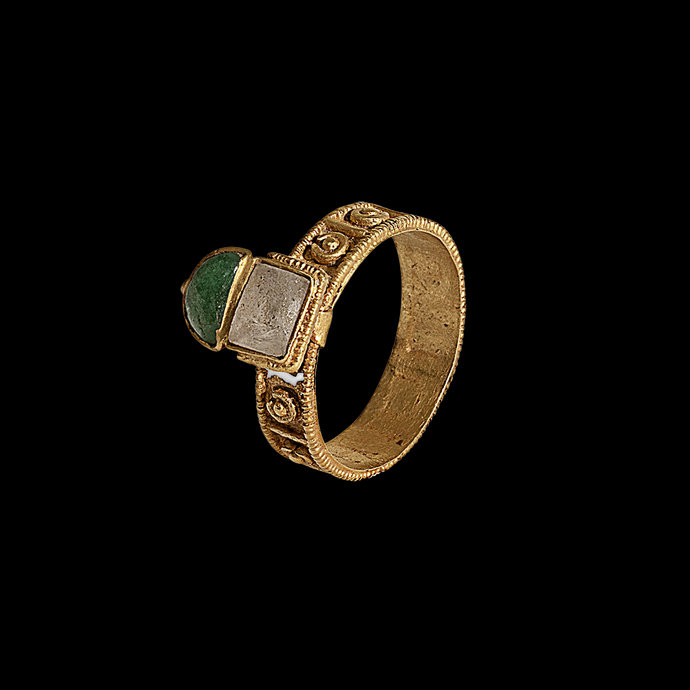


Gold Ring with Emerald and Rock Crystal
, Early Byzantine, 5th-6th century AD
Gold Ring with Emerald and Rock Crystal
Description
CHARMING EARLY BYZANTINE RING WITH EMERALD AND ROCK CRYSTAL DOUBLE BEZEL
Gold band decorated along the borders with beaded wire and a frieze of square ornaments, each centered by a globule framed with round wire. A small insert attached to the interior of the band forms the support for a double bezel, comprising an oblong pyramidal setting with a beaded border and a rock crystal cabochon, joined to a half-moon–shaped setting containing an emerald cabochon and accented by a gold globule. The ring shows age-related wear and has a small gap with loss of gold on one side of the hoop near the bezel.
Provenance:
United Kingdom, The Jonest Collection, published in: Diana Scarisbrick and Sonja Butler, Marvels in Miniature, The Jonest Collection of Rings, London 2024, p. 42, no. 18.
Literature:
Rings with double bezels appear during the Late Roman and early Byzantine periods, as well as in the Merovingian kingdoms. Hoop construction varies widely, ranging from solid gold or chiseled openwork bands to those decorated with filigree wire, as seen here. Bezel mounts likewise occur in a variety of forms, including inverted pyramidal, round, and oval shapes, as well as half-moon settings.
For museum examples of this ring type, see the Alice and Louis Koch Collection, Swiss National Museum, Zurich (Chadour 1994, vol. 1, nos. 426, 484, with further parallels); the British Museum, London (Marshall 1968, pl. XXI, no. 815); the Victoria and Albert Museum, London (Oman 1930, no. 239); and the Musées royaux d’art et d’histoire, Brussels (Hadjadj 2007, pp. 83–84, nos. 403, 474). Compare also Jeffrey Spier and Sandra Hindman, Byzantium and the West: Jewelry in the First Millennium, Les Enluminures 2007, no. 8, and Jeffrey Spier, “Some Unconventional Early Byzantine Rings,” in Chris Entwistle and Noël Adams (eds.), Intelligible Beauty: Recent Research on Byzantine Jewellery, London 2010, p. 18, figs. 18a–b.
Although the present ring is published in the Jonest Collection catalogue with a tentative date of the 11th–13th century, its style and construction support a more plausible attribution to the Early Byzantine period, most likely dating to the 5th–6th century AD. The use of emerald and rock crystal may have held personal significance for the wearer, functioning either as decorative elements or as stones endowed with symbolic meaning. Both gemstones were highly valued in the Byzantine world, and their combination appears frequently in ring settings. During this period, emeralds were typically sourced from Egypt, while rock crystal was likely imported from India.