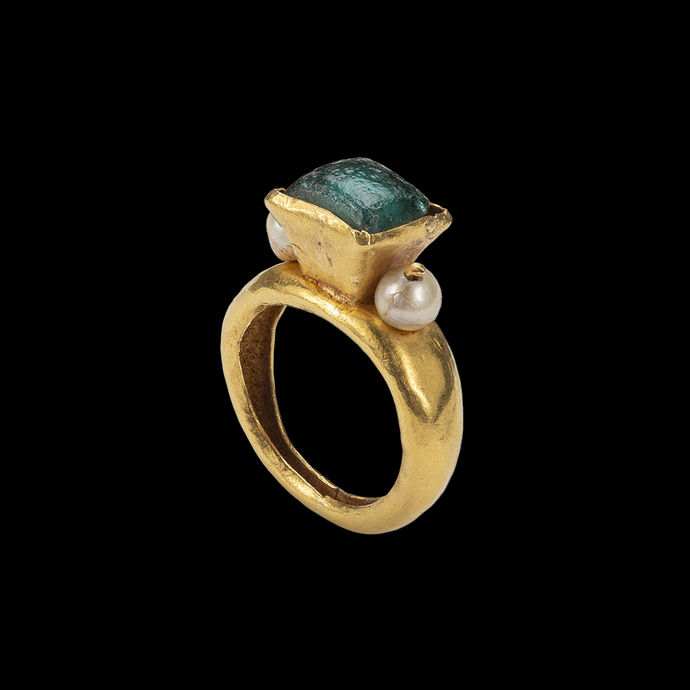


Byzantine Ring with Emerald Glass and Pearls
, Byzantine Empire, early 6th century AD
Byzantine Ring with Emerald Glass and Pearls
Description
RADIANT EARLY BYZANTINE RING SET WITH EMERALD-COLORED GLASS AND PEARLS
Gold ring with a wide hoop formed from sheet metal, convex on the exterior and concave on the interior, widening toward the flattened shoulders and the underside of the bezel. The bezel is of inverted pyramidal shape and is set with a rectangular emerald-colored glass cabochon. On either side of the bezel is a drilled natural pearl mounted on a gold pin attached to the hoop. The ring shows age-related wear with minor loss on one corner of the glass cabochon, but it remains in good, wearable condition.
Literature:
During the 4th century AD, the Roman Empire was divided into a Western Empire, governed from Rome until its collapse in the fifth century, and an Eastern Empire, later known as Byzantium, ruled by an emperor from Constantinople (modern Istanbul). The Eastern Empire prospered and grew steadily in power, enduring until its fall in 1453. Early Byzantine jewelry reflects influences from Late Roman traditions, particularly in the preference for emeralds and pearls, as exemplified by the present ring. Stylistically, however, the empire increasingly looked eastward, incorporating Greek and Near Eastern influences into its goldwork. Over time, Byzantine jewelry became progressively more sumptuous with increasingly complex designs.
The Emperor Justinian I (483–565) sought to regulate the wearing of jewelry with particular rigor. In the Corpus Juris Civilis (529–534), he decreed that pearls, emeralds, and hyacinths (sapphires) were to be reserved exclusively for the adornment and splendor of the sovereign. Exceptions were permitted; however, the extent to which this legislation was enforced in practice remains uncertain.
The use of glass as an imitation of gemstones, such as emeralds, was well established in Classical antiquity, particularly in Hellenistic Greek and Roman jewelry. This practice continued into the Byzantine period, when goldsmiths employed glass gems in both modest and high-status works. No doubt these rings with glass cabochons would have been relatively less costly, although still very valuable in view of the quantity of gold. For the production and use of glass in the Byzantine world, see Chris Entwistle and Liz James, New Light on Old Glass: Recent Research on Byzantine Mosaics and Glass, London 2013, pp. 82–88, 189–198.
A characteristic feature of Byzantine rings from the early 6th and 7th centuries AD is the bezel in the form of an inverted pyramid. For related examples, see Marvin C. Ross, Catalogue of the Byzantine and Early Medieval Antiquities in the Dumbarton Oaks Collection, Washington, DC 1965, vol. 2, no. 73; Jeffrey Spier and Sandra Hindman, Byzantium and the West: Jewelry in the First Millennium, Les Enluminures 2007, nos. 10–13; and Jeffrey Spier, “Some Unconventional Early Byzantine Rings,” in Chris Entwistle and Noël Adams (eds.), Intelligible Beauty: Recent Research on Byzantine Jewellery, London 2010, pp. 13–19, pls. 16–18. Such designs often incorporate a secondary bezel with a pearl mounted in a gold setting projecting from the side. Unusual in the present example is the attachment of drilled natural pearls directly to the hoop; these pearls would have been sourced from the Gulf region.