

Description
A MINIATURE GOLD BROOCH WHERE TWO HANDS JOIN IN LOVE
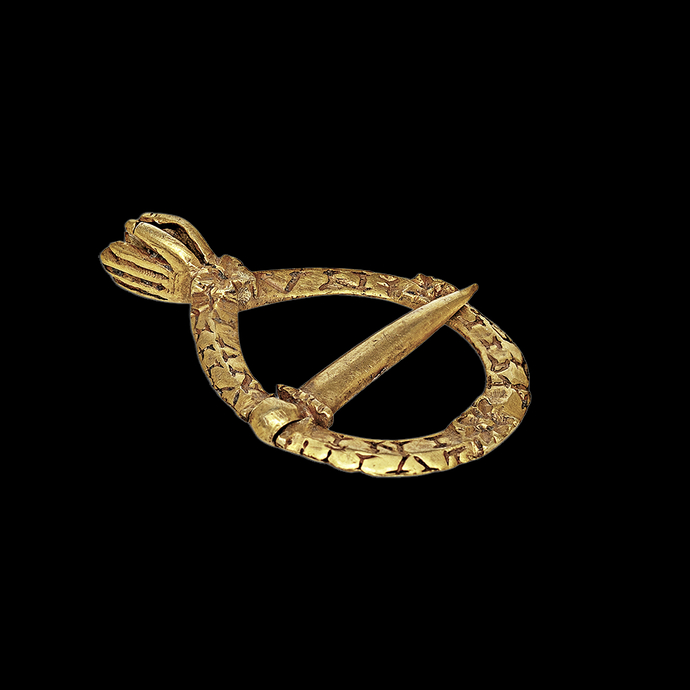
Flat gold hoop of oval form, terminating in a pair of joined hands. The fastening pin is mounted with a simple loop. The front is faceted into two circular surfaces, each bearing an inscription, punctuated with flowers and colons. Reading clockwise from the pin, the inscriptions show: inner circle, “N V I V N: I I M I N I”; outer circle, “V I I I T I: I: I – I I V L V I (?) I”. These inscriptions may represent a cipher that has yet to be deciphered. The brooch is in excellent condition.
Provenance:
Found by a metal detectorist in Boxley, Kent, on Friday, 3 August 2007. Registered with the Portable Antiquities Scheme under Unique ID KENT-984E65, Treasure Number 2007/T389.
Published in From Function to Fantasy, The Brooch, London 2025, p. 26, no. 27.
Literature:
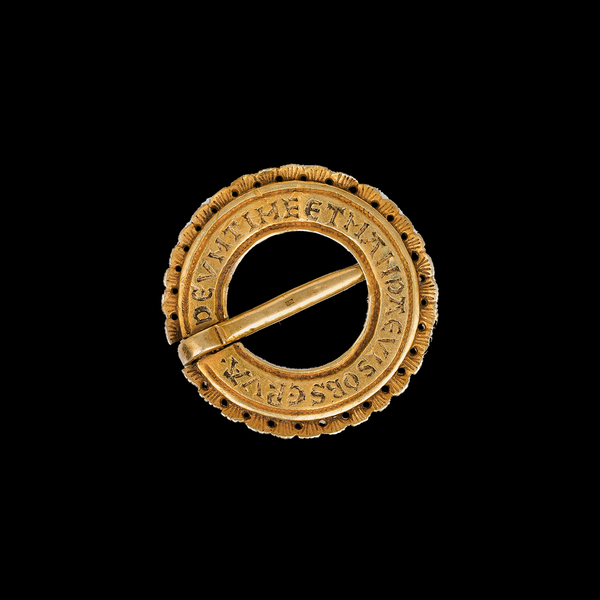
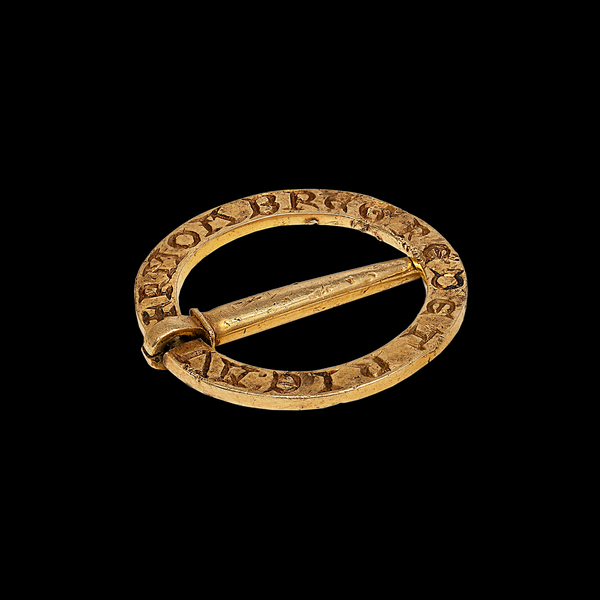
For a detailed study of medieval brooches, including ring brooches, see R. Lightbown, Medieval European Jewellery, especially pp. 147–158 on circular or “ring” designs. As Lightbown observes, “the ring brooch was broadly speaking the simplest and least assuming of mediaeval brooches, since it was essentially a practical fastener” (p. 147). Many examples bear inscriptions – some amorous, others religious. Symbols, heraldic devices, and mottos are also commonly found on the ring brooches.
The typology of ring brooches encompasses a wide range of forms, including the pure circle, as well as quatrefoil, hexagonal, wheel-like variants, and oval examples terminating in cupped or joined hands, as seen here. Such motif of joined hands appears on ring brooches as early as the thirteenth or early fourteenth century, like the present example. Medieval brooches have a long association with love tokens, and this particular type – often referred to as fede brooches for “Mani in Fede (hands in faith)” – were likely used in Northern Europe as gifts marking betrothal and marriage. Given the cupped form of the hands in our brooch, it is likely that it originally held a small gemstone, perhaps a pearl. For a detailed discussion of the fede motif on brooches, see Lightbown, pp. 183–184.
Comparable examples are preserved in several public collections, including a ring brooch in the British Museum with two hands still clasping an opal cabochon (P&E 1849,0301.33), dated to the late thirteenth or fourteenth century, and two further examples in the Victoria and Albert Museum, dated to the fourteenth century and published in Lightbown, cat. nos. 13–14, pp. 494–495.