

Description
MAGNIFICENT SAPPHIRE RING FILLED WITH LOVE AND GOOD WISHES
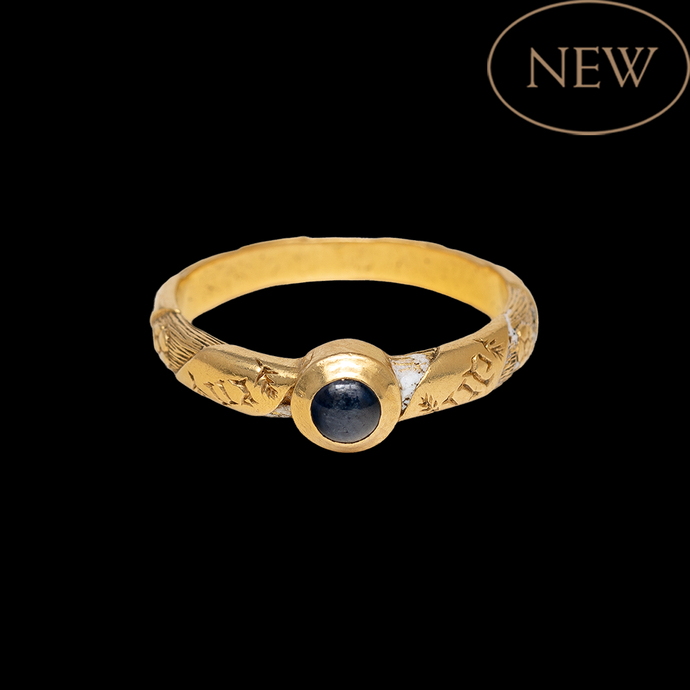
Gold ring with D-section hoop, plain on the interior and ornately chased and engraved on the exterior with a scroll bearing the French inscription in Gothic script “En Buon An” (“A Good Year”), accompanied by tiny sprigs, probably myrtle. The scroll appears to wrap around the hoop and is interspersed with forget-me-not flowers. A round sapphire cabochon is set in a closed collet bezel with tapered edge. Traces of white enamel remain along the hoop. The ring shows age-related wear and remains in good wearable condition.
Literature:
Posy rings derive their name from the term poésie, or poetry. These rings bear inscribed mottoes either in prose or verse. They enjoyed enduring popularity throughout the late Middle Ages and the Renaissance. Early examples like this one feature inscriptions in gothic letters visibly engraved on the exterior of the band, also called “black letter rings,” while later examples conceal their mottoes inside the hoop with their personal messages known only to the giver and recipient. Posy rings are mentioned in the plays of William Shakespeare (1564–1616), including Hamlet and The Merchant of Venice. From the fifteenth century onward, such rings were known to be exchanged between lovers, friends and family members expressing affection, friendship, faith, or, like the present ring, New Year wishes.
In late medieval and Renaissance England, it was customary to exchange gifts on New Year’s Day, and jewelry was a common choice. The French inscription “En Boen An”, wishing a Happy New Year, appears on many posy, iconographic, and heraldic rings. As French functioned as the language of courtly and aristocratic life in England from the Norman Conquest through the late Middle Ages, its use here suggests that the ring’s original owner belonged to the upper echelons of society—a status further confirmed by the ring’s exceptional workmanship, elaborate design, and refined use of enamel.
This ring was likely presented on New Year’s Day as a token of good luck and affection. The forget-me-not flowers on the present example emphasize its affectionate message, complemented by the sapphire, long symbolic of romantic love. For comparable love rings set with sapphires, see examples in the British Museum, London (Dalton 1912, no. 1005) and the Victoria and Albert Museum, London (inv. no. M.206-1975). The small sprigs accompanying the inscription likely represent myrtle, which since Antiquity has been associated with love and was sacred to Aphrodite/Venus, the goddess of love. For this symbolism, see Beatriz Chadour-Sampson, The Power of Love: Jewels, Romance and Eternity, London, 2019, pp. 17, 25–26. Variants of the inscription “en bon an” appear on fifteenth-century rings, including examples in the Ashmolean Museum, Oxford (Scarisbrick / Henig 2003, pp. 42–43, pl. 12); the Museum of London (inv. nos. A22158; A24240); and the British Museum (Dalton 1912, nos. 940–941; inv. no. 1960,1103.1).
For a history of posy rings with extensive examples ranging from the medieval to the eighteenth century, see Scarisbrick 2021; for further studies on posies, see A Garland of Love: A Collection of Posy-Ring Mottoes, London, 1907; Dalton 1912, pp. 174 ff.; Evans 1931; Oman 1974, pp. 39 ff.; Taylor and Scarisbrick 1978; Scarisbrick 2007, pp. 74 ff.