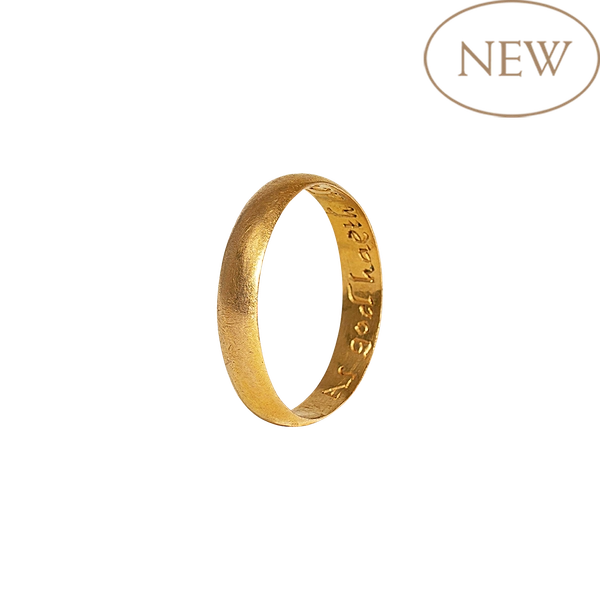


Posy Ring “x bien/+seler/+cei/amer”
, Probably England, 14th century
Posy Ring “x bien/+seler/+cei/amer”
Description
POSY RING BEARING THE “SECRET” MESSAGE OF COURTLY LOVE
Wide gold band, plain on the interior and engraved on the rounded exterior is an intricate scroll-like frieze against a hatched background with an inscription in French in black letters “x bien/+seler/+cei/amer.” Spaced between the inscription are four carved roundels imitating diamond-shaped faceted gemstones in cusped settings. The ring was formerly enameled. It shows signs of wear through age and remains in good, wearable condition.
Provenance:
United Kingdom, The Jonest Collection, published in: Diana Scarisbrick and Sonja Butler, Marvels in Miniature, The Jonest Collection of Rings, London 2024, p. 150, no. 102.
Literature:
Posy rings derive their name from the term poésie, or poetry. These rings bear inscribed mottoes either in prose or verse. They enjoyed enduring popularity throughout the late Middle Ages and the Renaissance. Earlier examples like here feature inscriptions in gothic letters visibly engraved on the exterior of the band, while later examples conceal their mottoes inside the hoop with their personal messages known only to the giver and recipient. Posy rings are mentioned in the plays of William Shakespeare (1564–1616), including Hamlet and The Merchant of Venice. From the fifteenth century onward, such rings were known to be exchanged between lovers, friends, and family members expressing affection, friendship, faith, or even New Year wishes. They enjoyed great popularity in England, especially as betrothal or wedding rings.
The design of this posy ring is exceptional, with the letters engraved within an elaborate scroll-like frieze and punctuated by four imitation gemstones, which would have appeared even more striking when enhanced by their original enamel. The ring can be situated within the broader tradition of courtly love, likely conceived as a lover’s gift. The inscription, in loosely rendered French, reads “x bien/+seler/+cei/amer,” an alternative spelling of “bien celer cet amor,” meaning “hide this love well.” Malcolm Jones (2024, pp. 8-9) records a comparable inscription “bien celer/cet alouer,” which he interprets as “to hide [love] well is to allow it.” Jones further connects such inscriptions to the literary convention of courtly love,which emphasized thatlove should be kept secret. As he observes, these “secret” messages of love could at times be “hidden in plain sight,” as on the present ring, where the inscription appears—rather unexpectedly—on the outer band.
The imperfect French message as well as the form of the ring itself suggest an English origin. This is supported by the existence of comparable rings such as one found in East Riding of Yorkshire (Portable Antiquities Scheme YORYM-4F2206). French remained the language of courtly and aristocratic life in England from the Norman Conquest through the later Middle Ages, and its use here points to an owner from the upper echelon of society.
For a history of posy rings with extensive examples ranging from the medieval to the eighteenth century, see Scarisbrick 2021; for further studies on posies, see A Garland of Love: A Collection of Posy-Ring Mottoes, London, 1907; Dalton 1912, pp. 174 ff.; Evans 1931; Oman 1974, pp. 39 ff.; Taylor and Scarisbrick 1978; Scarisbrick 2007, pp. 74 ff. See also for an analysis of posies found on rings, ring brooches, and seals: Malcolm Jones, “The Beautiful Game: Courtly Love Posies in Anglo Norman Inscribed Jewellery and Seals,” in Journal of the British Archaeological Association, 2024, 177:1, pp. 101-130.
We are grateful to Marc Smith for his expertise.