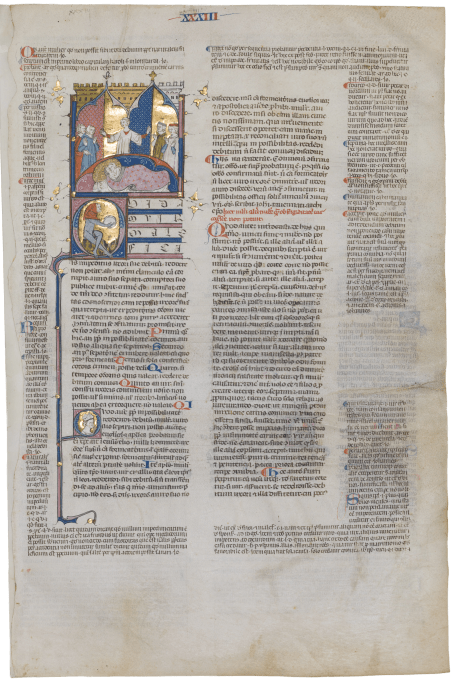


c. 83 x 74 mm (miniature)
c. 83 x 74 mm (miniature)
Description
provenance
Parent manuscript, Toulouse;
Then perhaps Pierre Soybert (d. 1454) in Saint-Papoul, France;
Cabinet M. Petit Radel, architect, Paris, in 1839;
London, Sam Fogg, 2006;
Acquired Robert McCarthy (BM 1646)
literature
Literature:
Bilotta 2008;
Stones 2014, vol. 1, p. 77, vol. 2, pp. 156, 158, 160–64, ills. 315, 321, 322, col. pl. 4;
Kidd 2021, no. 70, pp. 235–43;
Related literature:
Friedberg 1959;
L’Engle and Gibbs 2001
learn
Gratian Fragments Master
France, Toulouse, c. 1310–1320
The artist of a set of twenty-two illuminated leaves from a grand manuscript of the Decretals by Gratian with the gloss of Bartholomew of Brescia (d. 1258) was named the Gratian Fragments Master by Alison Stones. According to Stones and to Maria Alessandra Bilotta, who have studied the group of fragments in depth, this anonymous master can be confidently localized in Toulouse in the second decade of the fourteenth century. His style is characterized especially by the pointed architectural turrets with crenelated walls behind them, by the different combinations of diapered backgrounds sometimes with fabrics hanging, and by the lavish use of gold and bright primary colors, the red veering toward an orange tone. His figures are animated, often with pronounced, gesticulating hands. There is a playful spirit to his art as well, evident in the historiated initials that accompany his grand miniatures for the Causae and the marginal decorations. Two of the leaves are inscribed “Soybret” or “Soyberti,” which suggests that they might have been owned by a jurist-bishop, Pierre Soybert (d. 1454) in Saint-Papoul about forty miles southeast of Toulouse. By the beginning of the fourteenth century, Toulouse was a thriving metropolis with 35,000 inhabitants, a royal stronghold, a center of trade and culture, and a university founded in 1229, which rivaled that of Bologna for the study of law. Several manuscripts have been associated with the style of the Gratian Fragments Master, if not by his hand and if not all from Toulouse. These include the magnificent Missal of La Grasse, whose patron was Auger de Cogeux (1279–1309), abbot of the most distinguished Benedictine monastery in La Grasse, closer to Narbonne than to Toulouse itself (London, British Library, Add. MS 17006); a Summa super Decretum Gratiani by Uguccione da Pisa (Verona, Biblioteca Capitolare MS CXCIV), usually localized in Avignon; and a Decretals of Clement V, now datable to c. 1320 in Toulouse (Brescia, Biblioteca Civica Queriniana, MS B.I.1).