1
77

None
Hide caption

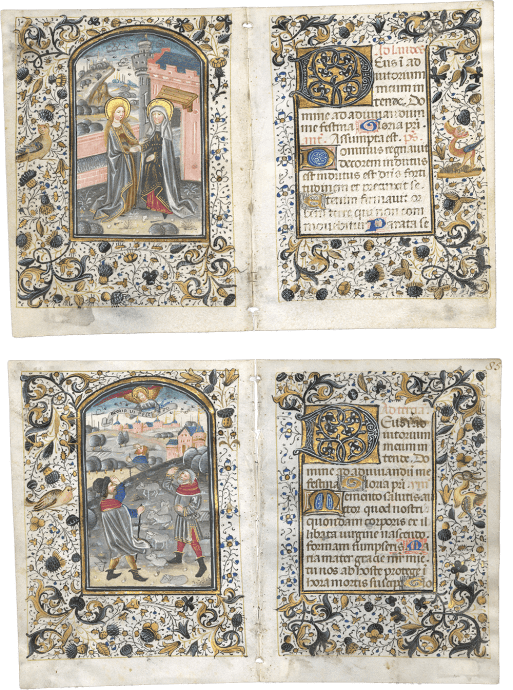
Circle of Willem Vrelant, Southern Netherlands, almost certainly Bruges, c. 1460–1470
The Visitation and The Annunciation to the Shepherds, two bifolia from a Book of Hours
92 × 65 mm (bifolia)
60 × 40 mm (miniature)
60 × 40 mm (miniature)
Circle of Willem Vrelant
The Visitation and The Annunciation to the Shepherds, two bifolia from a Book of Hours
Southern Netherlands, almost certainly Bruges, c. 1460–1470
92 × 65 mm (bifolia)
60 × 40 mm (miniature)
60 × 40 mm (miniature)
$45000.00
These two delicate bifolia are characteristic of Vrelant’s style. On the Visitation leaf, Mary embraces her cousin Elizabeth, both of them pregnant, outside a city gate set within a hilly landscape. Mary carries Jesus and Elizabeth bears John the Baptist. In the miniature, Mary clasps her cousin’s hand with a gentle smile, while Elizabeth, one hand pressed to her swelling belly, responds to the stirring within. The Annunciation to the Shepherds unfolds in an open countryside, with distant views of a medieval town reminiscent of those found in Vrelant’s own surroundings.
%3Cdiv%20class%3D%22title%22%3E%3Cem%3ECircle%20of%20Willem%20Vrelant%3C%2Fem%3E%2C%20Southern%20Netherlands%2C%20almost%20certainly%20Bruges%2C%20%20c.%201460%E2%80%931470%3C%2Fdiv%3E%0D%3Cdiv%20class%3D%22medium%22%3EThe%20Visitation%20and%20The%20Annunciation%20to%20the%20Shepherds%2C%20two%20bifolia%20from%20a%20Book%20of%20Hours%3C%2Fdiv%3E%0D%3Cdiv%20class%3D%22dimensions%22%3E92%20%C3%97%2065%20mm%20%28bifolia%29%20%3Cbr%2F%3E%2060%20%C3%97%2040%20mm%20%28miniature%29%3C%2Fdiv%3E
1
77
Description
These two delicate bifolia are characteristic of Vrelant’s style. On the Visitation leaf, Mary embraces her cousin Elizabeth, both of them pregnant, outside a city gate set within a hilly landscape. Mary carries Jesus and Elizabeth bears John the Baptist. In the miniature, Mary clasps her cousin’s hand with a gentle smile, while Elizabeth, one hand pressed to her swelling belly, responds to the stirring within. The Annunciation to the Shepherds unfolds in an open countryside, with distant views of a medieval town reminiscent of those found in Vrelant’s own surroundings. The shepherds were tending their flocks in the fields near Bethlehem when an angel suddenly appeared to announce the birth of the Savior. Immediately afterward, a great multitude of angels joined in triumphant praise: “Gloria in excelsis Deo” (Glory to God in the highest heaven), rendered here on the unfurled banderole. The leaves come from a now disassembled Book of Hours made in Bruges. The Italianate script suggests that the book was probably intended for an Italian or Iberian clientele. Vrelant is known to have worked for prominent foreign patrons such as Juana Enriquez (consort of King Juan II of Aragon) and the Genoese nobleman Paolo Battista Spinola. His circle also produced manuscripts for Italian clients, including four Books of Hours now in the Walters Art Museum (MSS W. 177, 179, 180, 183).
Notable here is the use of grisaille, a painting technique built on varying shades of gray. Originating with Giotto’s sculpture-like figures of Virtues and Vices in the Scrovegni Chapel, grisaille was adopted by French illuminators later in the fourteenth century and finally reached full development in the Southern Netherlands in the fifteenth century, exemplified in the outer panels of the Ghent Altarpiece by Hubert and Jan van Eyck. The interest in grisaille extended to Vrelant’s circle, and Philip the Good commissioned several grisaille manuscripts from him in the 1450s and 1460s. The present leaves demonstrate a rhythmic handling of the technique: while the draperies and much of the landscape are rendered in grayscale, other areas remain in full color. The subdued monochrome is enlivened by passages of richly saturated colors, most notably deep ultramarines, sumptuous burgundy reds, and warm fleshy magentas characteristic of Vrelant and his circle. A group of surviving Books of Hours features comparable semi-grisaille miniatures and borders—for example, the Hours of Jacques de Brégilles (London, British Library, Yates Thompson MS 4) likely by Vrelant’s own hand, as well as two others from his circle (Baltimore, Walters Art Museum MS W. 180, New York, Morgan Library MS M.25). The two Vrelant miniatures in the Brégilles Hours closely parallel the present leaves in their ornate foliate borders with whimsical drolleries and birds.
On an intimate scale, Vrelant’s work evokes Bruges panel paintings of his day, and he is credited with introducing new compositions and iconography drawn from earlier and contemporary painters such as Jan van Eyck and Hans Memling. Vrelant would have known Memling personally: in 1478 he commissioned from the celebrated painter a pair of wings for a retable made for the guild of Saint John the Evangelist. The painting, now lost, presumably featured Vrelant and his wife Mary as donor figures. The present miniatures also bear subtle connections with Memling. Note the meandering landscape with a remarkable sense of depth as well as the elaborate architectural details, reminiscent of Memling’s Saint Christopher and Saint Stephen panels and Scenes from the Passion of Christ. Both aspects were extensively reinterpreted by Vrelant in one of his most important works, the Chroniques de Hainaut (Brussels, KBR, MS 9243, e.g., ff. 60, 64, 134v).
Xijuan Yao
provenance
Parent manuscript: Lewis Curwood Berger (1814–1904), recorded as having a 19th-century bookplate of L. C. Berger (presumably Franks no. 2306);
Anonymous owner;
Sold at Christie's, London, Illuminated Manuscripts, Illustrated Books, Autograph Letters and Music, 29 June 1994, lot 37;
Subsequently broken up;
Leaves: John Louis Feldman, Colorado and New York (1957–2021);
Robert McCarthy, BM 1120a, 1120b, acquired from Feldman in September 1997.
literature
Literature:
Kidd 2018, no. 27, pp. 134–36;
Related literature:
Farquhar 1974; Korteweg in van der Horst and Klamt 1991, pp. 109–22;
Dogaer 1987;
Bousmanne 1997;
Smeyers 1998; van Buren 1999;
Los Angeles and London 2003;
Delcourt and Bousmanne 2011;
Adam 2023.
learn
Willem Vrelant
Southern Netherlands, Bruges, active c. 1454–1481 (active in Utrecht c. 1449–1454)
We know from the city archives of Utrecht that a “Willem Backer” of Vreeland was registered as a citizen there in 1449. This is the earliest documented reference to Willem Vrelant, one of the most prolific, influential, and commercially successful illuminators of the third quarter of the fifteenth century. He may have spent several years training in Utrecht, where in 1450 he collaborated with the Master of Catherine of Cleves on a Book of Hours for the Utrecht viscount Willem van Montfort (Vienna, ÖNB, cod ser. n. 12878). Vrelant relocated to Bruges sometime before 1454, the year his name first appeared in the newly founded bookmaker’s guild of Saint John the Evangelist. A mass celebrated in his honor on 19 June 1481 presumably marked his death. Vrelant enjoyed wide patronage from both local and foreign clientele. He worked on numerous commissions from the Burgundian court, including the Breviary of Philip the Good (Brussels, KBR, MS 9511, 9026), the Speculum Historiale of Louis de Gruuthuse (Paris, BnF, MS fr. 308–311). In 1468 the treasurer of Charles the Bold recorded a payment of 4 livres 6 sous to Guillaume Wyelant (Vrelant) for his illuminations and for the binding of the second volume of a Chroniques de Hainaut (Brussels, KBR, MS 9243). Bruges’s central position within the Hanseatic League also ensured Vrelant a prominent role in the export market. His commercial success was extraordinary, and his style became so widely admired and imitated that hundreds of manuscripts are today associated with his circle; of these, some seventy were illuminated all or in part by himself. With a large, productive workshop and a near-monopoly in Bruges, Vrelant acted as a true entrepreneur, likely also as a libraire coordinating and subcontracting painters, scribes, and binders. Recent scholarship has proposed the possibility of a family-based atelier, involving several apprentices and collaborators, among them Vrelant’s wife (possibly the Master of the Vraie Cronicque descoce) and his daughters.