
None
Hide caption

Lombard Illuminator, Italy, Mantua or Brescia, c. 1500
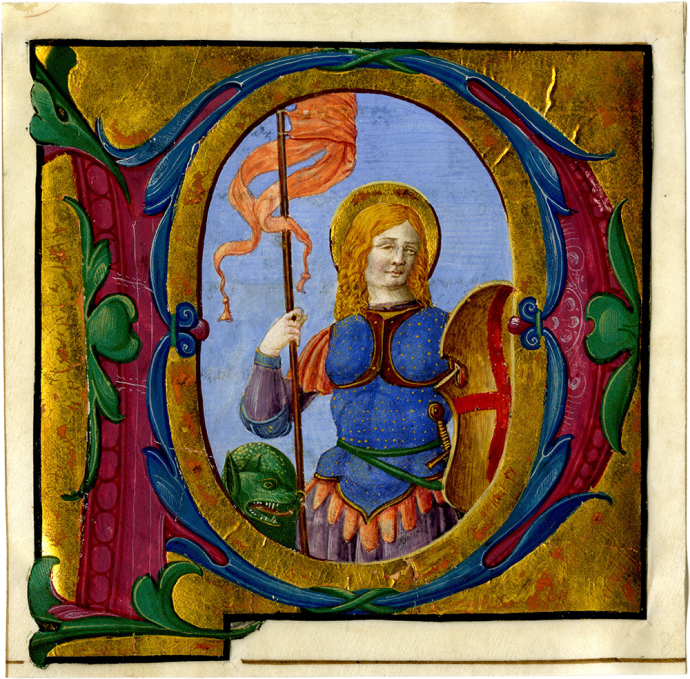
Saint George and the Dragon, in an initial ‘P’ from a Choir Book
115 x 117 mm
Lombard Illuminator
Saint George and the Dragon, in an initial ‘P’ from a Choir Book
Italy, Mantua or Brescia, c. 1500
115 x 117 mm
$55000.00
This finely painted initial ‘P’ for “Protexisti me Deus” (Protect me, O God), the introit for the feast of Saint George, contains a half-length standing figure of Saint George, occupying almost the entire body of the initial. The saint stands elegantly, holding in his right hand a tall banner with flowing orange-red drapery, while his left arm supports a shield decorated with the red cross.
%3Cdiv%20class%3D%22title%22%3E%3Cem%3ELombard%20Illuminator%3C%2Fem%3E%2C%20Italy%2C%20Mantua%20or%20Brescia%2C%20c.%201500%3C%2Fdiv%3E%0D%3Cdiv%20class%3D%22medium%22%3ESaint%20George%20and%20the%20Dragon%2C%20in%20an%20initial%20%E2%80%98P%E2%80%99%20from%20a%20Choir%20Book%3C%2Fdiv%3E%0D%3Cdiv%20class%3D%22dimensions%22%3E115%20x%20117%20mm%3C%2Fdiv%3E
8
77
Description
This finely painted initial ‘P’ for “Protexisti me Deus” (Protect me, O God), the introit for the feast of Saint George, April 23) contains a half-length standing figure of Saint George, occupying almost the entire body of the initial. The saint stands elegantly, holding in his right hand a tall banner with flowing orange-red drapery, while his left arm supports a shield decorated with the red cross. He is wearing richly detailed armor, with a blue, gold-speckled cuirass and articulated shoulder plates, worn over a violet tunic whose scalloped hems emerge beneath it. His long, wavy blond hair frames a serene face, highlighted by a golden halo. Behind the saint opens a soft, light blue sky, creating a calm atmospheric backdrop that enhances the monumentality of the figure. Partially emerging within the frame of the letter, appears the captive dragon’s green head. The letter itself is elaborately ornamented, combining lush foliate motifs in pinks, greens, and blues while the background is filled with gold.
This miniature has been well known since it first appeared in the Rodolphe Kann Collection in Paris in 1907, when it belonged to a group of nineteen cut-out initials mounted on three sheets. In 1947, William Suida recognized the group as the work of a single Lombard master, stylistically close to the anonymous Master of the Arcimboldi Missal who illuminated a Missal for the Milanese bishop Guido Antonio Arcimboldi (Milan, Bibl. Capitolare, MS. II.D.I.13) for the investiture of Ludovico il Moro as Duke of Milan. More recently, Milvia Bollati highlighted some heterogeneous characteristics among the nineteen cuttings from the Kann Collection, attributing some of them to a Veronese illuminator from the workshop of Francesco and Girolamo dai Libri. However, she maintains that a substantial part of the initials from the Kann group, including our initial ‘P’ with Saint George, are stylistically close, should be dated c. 1500, and attributed to the same anonymous Lombard artist. Three of them are currently at the Musée Marmottan Monet, from the Wildenstein Collection (Initial ‘S’, A Papal Saint with two unidentified Young Saints, M6103; Initial ’G’, Saint Agatha, M6104; Initial ‘L’, Saint Sebastian, M6105), one in Richmond, at the Virginia Museum of Fine Arts (Initial ‘M’, Two Apostles, acc. no. 63-7-3) and one in the Getty Museum (Saint John the Baptist, 2025.63). The connection between these fragments is indeed evident, particularly in the treatment of the figure with its delicate features, three-quarter view face, and flowing blond hair.
However, scholars do not unanimously support the idea that this group should be attributed to two different hands. In 1996, Laura Gnaccolini had linked the group of Kann initials with a discrete corpus of works (including Brescia, Bibl. Civica Queriniana H IV 9; Kraków, Biblioteka Jagiellońska, I.R. 1904; Berlin, Kupferstichkabinett, inv. 6219–6220) all assigned to an anonymous artist who, while stylistically close to the Master of the Arcimboldi Missal, is nevertheless distinct from him. This artist appears to have worked first in the Benedictine Abbey of Polirone (Mantua) and later in Brescia around 1500. In 2019, Beatrice Alai, in her description of the Kupferstichkabinett folios, concurred with Gnaccolini and attributed the Kann initials to an early phase in this anonymous Lombard artist’s activity, together with the initial in Kraków.
The ongoing research devoted to the corpus of this Lombard illuminator, still anonymous yet increasingly well defined, attests to the fertile renewal of manuscript illumination in late Quattrocento northern Italy and underscores the importance of developing a deeper understanding of this rich and complex artistic milieu.
Gaia Grizzi
provenance
Paris, Collection Rodolphe Kann, as of 1907;
Mrs. Collis P. Huntington, San Marino, California;
Exhibited: Los Angeles, Medieval and Renaissance Illuminated Manuscripts: A loan Exhibition, Los Angeles, County Museum, 1953–1954;
Duveen Brothers, New York;
Denys Sutton (1917–1991), London, purchased 27 December 1963;
The Norton Simon Foundation;
Sold London, Sotheby’s, 7 July 1974, lot 19;
London, Christie’s, June 4 2008, lot 33;
Les Enluminures, Catalogue 1991–2011, 20–20, no. 4;
USA, Private collection.
literature
:
Mannheim and Rahir 1907, no. 75, pp. 60-61;
Suida 1947, pp. 26–27;
Bollati in Hindman and Toniolo 2021, no. 35, pp. 348–53.
Related literature:
Gnaccolini 1996; Alai 2019, cat. 93, pp. 305–307