
None
Hide caption

Masters of the Suffrages, Northern Netherlands, probably Leiden, c. 1510
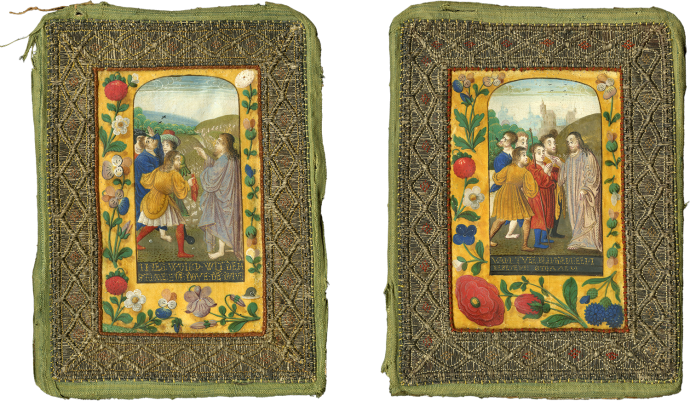
a. Christ Drives out the Devils
b. Christ Curing the Blind and Mute
b. Christ Curing the Blind and Mute
200 x 147 mm (textile frame)
131 x 80 mm (miniature)
131 x 80 mm (miniature)
Masters of the Suffrages
a. Christ Drives out the Devils
b. Christ Curing the Blind and Mute
b. Christ Curing the Blind and Mute
Northern Netherlands, probably Leiden, c. 1510
200 x 147 mm (textile frame)
131 x 80 mm (miniature)
131 x 80 mm (miniature)
$60000.00
Landscape, background sky and clouds, palette, figural types, and borders all secure these miniatures within the workshop of the Masters of the Suffrages with close comparisons to the name-manuscript in Vienna.
%3Cdiv%20class%3D%22title%22%3E%3Cem%3EMasters%20of%20the%20Suffrages%3C/em%3E%2C%20Northern%20Netherlands%2C%20probably%20Leiden%2C%20c.%201510%3C/div%3E%0D%3Cdiv%20class%3D%22medium%22%3Ea.%20Christ%20Drives%20out%20the%20Devils%20%3Cbr/%3E%3Cbr%20/%3E%0Ab.%20Christ%20Curing%20the%20Blind%20and%20Mute%3C/div%3E%0D%3Cdiv%20class%3D%22dimensions%22%3E200%20x%20147%20mm%20%28textile%20frame%29%20%3Cbr/%3E%20131%20x%2080%20%20mm%20%20%28miniature%29%3C/div%3E
2
77
Description
Landscape, background sky and clouds, palette, figural types, and borders all secure these miniatures within the workshop of the Masters of the Suffrages with close comparisons to the name-manuscript in Vienna. Introduced by simple captions in Dutch on a black ground, the subjects of the miniatures are healing miracles of Christ taken from the Gospels of Mark (7:31–37) and Matthew (9:27–31). Christ casts out demons in each of the illuminations, and in the second he also cures the blind who appear before him with their eyes closed. Surrounded by strewn flower borders typical of the artists of this group, the miniatures must have originally been conceived to be placed in manuscripts, since the painted borders are wider on the left (outer) side than on the right (gutter) side. However, their versos are both blank, and they are instead surrounded by embroidered textiles carefully sewn onto the parchment and stitched in colored linen or silk with threads of gold and silver. All inquiries suggest that the textiles are contemporary with the miniatures, so that the miniatures are thus rare survivals of illuminations not used in books at all but prepared for some kind of free-standing display.
Such a display would not have been unprecedented. There is an illumination of Saint Brigit, inclusive of its strewn flower borders, framed in the early sixteenth century within borders of embroidered textile sewn with tiny relics of saints in the convent of the Zwartzusters van Bethel in Bruges. A similar devotional composition in the abbey of Saint Godelieve in Bruges surrounds a panel of Saints Simon, Nicholas, and Thomas with relics and textiles. A Netherlandish liturgical cope of c. 1500 with stitched borders of stump work and lozenges of gold and silver thread composed like those surrounding these two miniatures. It is worth noting here that the principal export trade of medieval Leiden was weaving and the sale of textiles. Imitation textile grounds appear in the Prayerbook of Charles the Bold, enclosing a miniature of the Virgin and Child (Los Angeles, Getty Museum, MS 37, f. 10).
We cannot know precisely how the illuminations would have been displayed, but the existence of five others of the same series illustrating the healing ministry of Christ, all stitched with matching embroidered borders, raises the possibility that they were framed together perhaps on a wooden shrine. T here are seven in total. Four were sold at Sotheby’s in December 1994, the two here, one in the National Museum of Western Art at Ueno in Tokyo, and the other in a private collection in New York. Three others exist in the Carnegie Museum of Art in Pittsburgh. Additional scenes include Christ and a Pharisee, Christ Presenting the Keys of Heaven to Saint Peter, and the Wedding at Cana, the former in New York and the latter two in Pittsburgh. All probably come from the same dealer, A. Olivetti, in Florence in 1925, when the shrine may still have been intact.
provenance
According to labels on the versos (since removed), the present leaves were purchased in Florence in February 1926;
sold London, Sotheby’s, 5 December 1994, lot 14 (set of four);
Sandra Hindman, The Art Institute of Chicago, on deposit, 2018–2025; exhibited 27 January to 28 May 2018.
literature
Literature:
van Delft and van der Vlist in Leiden 2011, p. 186, figs. 8, 16;
Related literature:
Utrecht and New York 1989–1990, pp. 287–88;
Hamburger 1997;
Rudy 2015; de Hamel 2018, pp. 174–87, 247–48.
learn
The Masters of the Suffrages
Northern Netherlands, probably Leiden, active c. 1500–1525
The collaborating hands now known collectively as the Masters of the Suffrages are so named from a series of devotional images inserted into a section of suffrages, or prayers to the saints, in a Book of Hours illuminated by the miniaturist Spierinck probably in Utrecht and now in Vienna (Österreichische Nationalbibliothek, Cod. s.n. 13236). One manuscript from the group belonged to a Canon of Saint Pancras in Leiden (Paris, Bibliothèque de l’Arsenal, MS 160), and stylistic affinities with other localizable books make it likely the artists were working in Leiden. There is documentary evidence that the Augustinian Canons Regular of Hieronymusdal in central Leiden, known as Lopsen, were illuminating manuscripts, and it is regarded as possible that the anonymous Masters of the Suffrages were members of that abbey. The Dutch mannerist painter Cornelis Engelbrechtzoon (c. 1462–1527), teacher of Lucas van Leyden, is thought to have been trained as a painter in this same monastery. Active between about 1500 to 1520, the group of illuminators are considered followers of the illuminators known as the Masters of Hugo Jansz. van Woerden, whose substantial oeuvre can be situated in Leiden between the 1480s and about 1500. The Suffrage Masters were enormously popular, as evidenced by the fact that many of their miniatures seem to have been added to older manuscripts, thus updating them. Their illuminations, often introducing new up-to-date themes, are typically found with strewn borders, a Northern Netherlandish version of the Ghent-Bruges trompe l’oeil borders, and they appear with North Holland penwork of the “wild,” “mask,” and “scallop” groups.