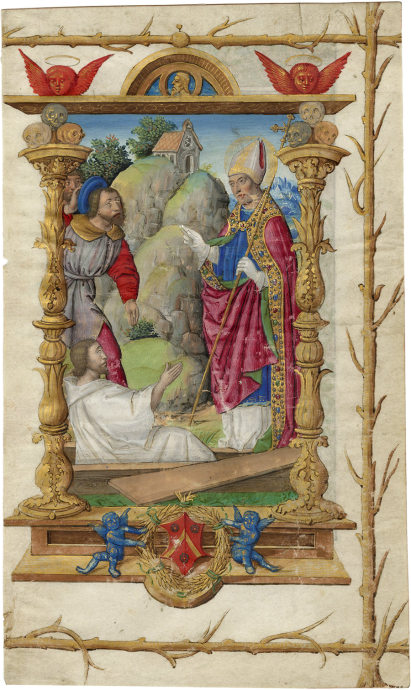


Description
provenance
literature
Related literature:
Avril and Reynaud 1993, pp. 312–13;
Wieck 1999, pp. 136-38;
Hofmann 2004, pp. 108–114;
Zöhl 2004.
learn
Jean Pichore
France, Paris, active, 1501–1521
Jean Pichore (Jehan Pychore, Jean Pichoyre) was the most successful and sought after manuscript illuminator in Paris during the first two decades of the sixteenth century. His output is vast, and he must have maintained a large workshop, assigning lesser illuminations to assistants and apprentices and reserving the most important, often the frontispieces, for himself. Documents assign his earliest work to the patronage of Cardinal Georges d’Ambroise, Archbishop of Rouen, at the Château de Gaillon in 1502–1503, notably a City of God (Paris, BnF, MS lat. 2070) and a Flavius Josephus, Antiquités judaïques (Paris, Bibliothèque Mazarine, MS 1581). Although originally considered as works of the School of Rouen, these manuscripts are now understood to be thoroughly Parisian, and the documents describe Pichore as “enlumineur et historieur…demourant à Paris” (illuminator and historiator…living in Paris). In 1517, the échevins of the city of Amiens ordered a Chants royaux representing an important series of tableaux dedicated to the Virgin of the Cathedral of Amiens to be presented to Louise de Savoy (Paris, BnF, MS fr. 145). In 1520, Pichore sold land to the Hôtel-Dieu in Paris for a house situated between the rue de Seine and the rue Mazarine, which he owned at least since 1510. The last document to mention him by name is a civil lawsuit of 5 August 1521 in which he represents his three sons, who collaborated with him on the Chants royaux and to whom payment was still owed. The entrepreneurial Pichore also tried his hand at the new art of printing, going into partnership in 1504 with Rene de Laistre (otherwise unknown) to adapt his manuscript illuminations to designs for metalcuts. His best work is considered to be a copy of Petrarch’s Remedes de l’une et l'autre fortune offered to King Louis XII in 1503 or a little after (Paris, BnF, MS fr. 225). He frequently collaborated with another important personality in Parisian manuscript production, the Master of Petrarch’s Triumphs.