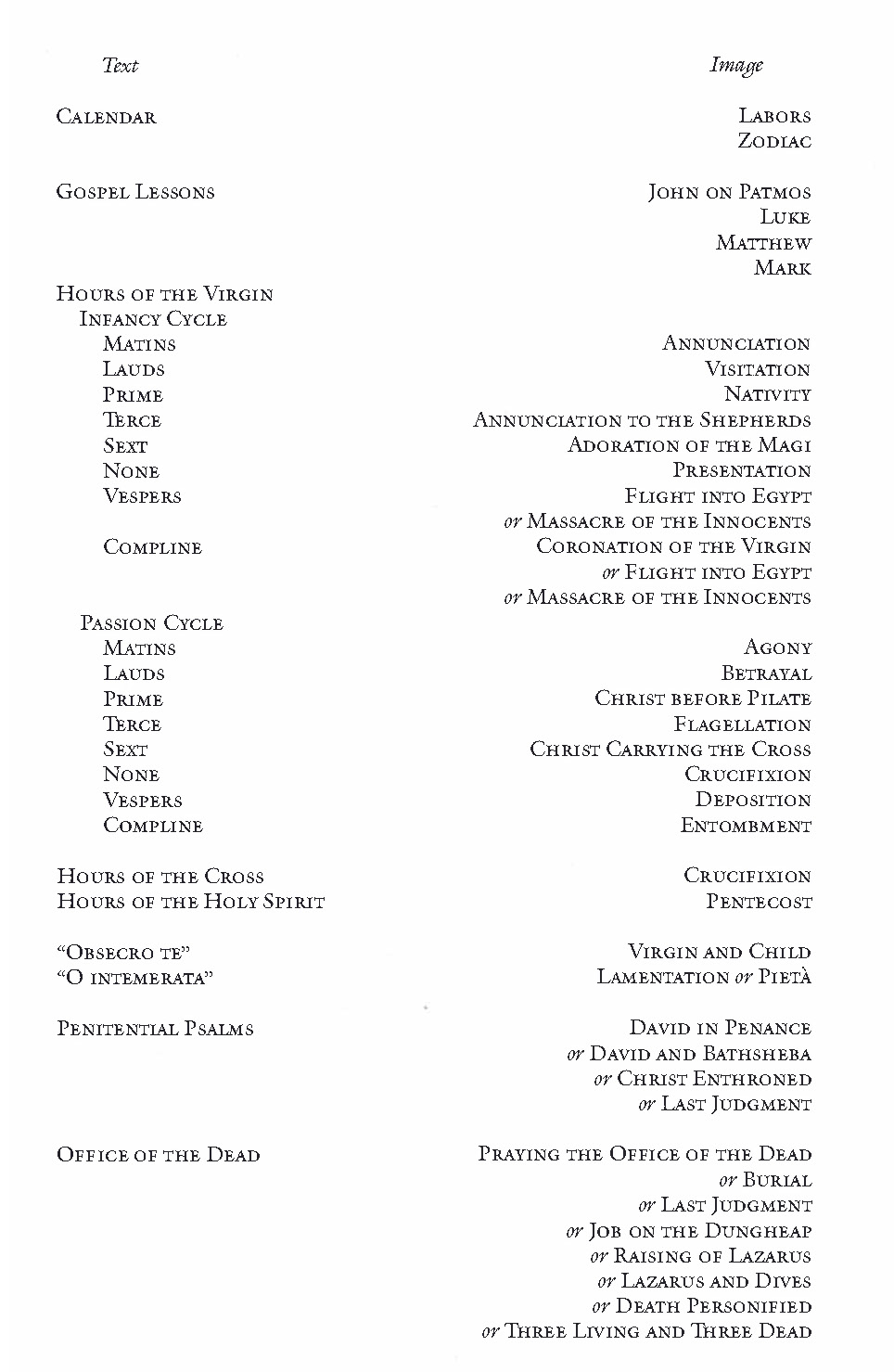
Although every Book of Hours is unique depending on regional traditions and the preferences of their patrons, a basic structure is common to all. Much of the text is drawn from the Bible but rearranged for devotional use. Knowing this basic structure makes a Book of Hours easier to navigate. The outline below presents the “skeleton” of a typical Book of Hours.
1. Calendar
A calendar opens a Book of Hours and lists the feast days celebrated throughout the year.
Local saints on the calendar offer clues to the region or community for which the manuscript was intended. Calendars are often illustrated with Zodiac Signs and the Labors of the Months.
2. Gospel Lessons
Short excerpts from each of the four Gospels usually follow the Calendar. They introduce important episodes from the life of Christ and are sometimes prefaced by miniatures of the Four Evangelists.
3. Hours of the Virgin
This text forms the core of a Book of Hours and gives the book its name (Horae, or “Hours”). It is organized according to the eight canonical Hours—the monastic schedule of prayers observed at appointed times throughout the day. In illuminated manuscripts, each Hour is usually introduced by a scene from the lives of Christ and Virgin Mary.
4. Hours of the Cross and Hours of the Holy Spirit
Generally following the Hours of the Virgin, these shorter Hours honor Christ’s Passion and the Holy Spirit. The Crucifixion and Pentecost are the most common illustrations for these sections.
5. Obsecro te and O intemerata
These are two of the most common prayers addressed to the Virgin, known by their Latin opening words: Obsecro te (“I beseech you”) and O intemerata (“O immaculate Virgin”). Appearing in nearly all Books of Hours, sometimes they can shed light on the patron’s identity, especially their gender.
6. Penitential Psalms and Litany
Medieval tradition ascribed the authorship of the Seven Penitential Psalms (6, 31, 37, 50, 101, 129, and 142) to King David, who composed them as penance for his grievous sins. These are followed immediately by the Litany, a hypnotic enumeration of saints called upon to pray for the reader.
7. Office of the Dead
Toward the end of most Books of Hours, the Office of the Dead includes readings from the Book of Job. The varied imagery—funerals, burials, scenes from the life of Job—is especially revealing of medieval attitudes toward death and mortality.
8. Suffrages
Near the end of a typical Book of Hours are usually a dozen or so Suffrages: short, intercessory prayers addressed to individual saints. Owners could personalize this section to invoke particular saints for protection, for example, Margaret for childbirth, Apollonia for dental problems, and Christopher for safe travel.
9. Accessory Texts
Books of Hours may also contain ancillary texts. Common choices include the Joys of the Virgin, the Seven Prayers of St. Gregory, the Seven Verses of St. Bernard, the Seven Last Words of Christ, and additional Hours dedicated to particular saints.
For three hundred years, from c. 1250 to c. 1550, the Book of Hours was the bestseller of the late Middle Ages and the Renaissance. The core of the Book of Hours is the Office of the Virgin Mary, with its set of prayers to be recited at home eight different times, or hours, of the day, just as monks chanted the office during the eight monastic hours. Books of Hours still exist on the market in greater number than any other type of medieval manuscript.
Books of Hours are remarkably varied. Everyday versions were sometimes written on paper with modest ornamentation. Deluxe versions were nearly always copied on fine parchment and richly illuminated with precious gold leaf and lapis lazuli by the best artists of the day. Kings and queens, princes and princesses, doctors, lawyers, merchants, housewives, and even children, who learned to read from them, owned Books of Hours. Wealthy women often received illuminated Books of Hours as dowry presents. Recording in them milestones of family history, they passed them down from generation to generation as heirlooms.
Different texts and illustrations are typically found together in Books of Hours. Recited in honor of the Blessed Virgin Mary, the Hours of the Virgin, is illustrated with the Christmas story, made up of scenes from the early life of Christ. Other sets of readings include the Hours of the Cross and the Hours of the Holy Spirit. Typically illustrated with an image of King David, the Penitential Psalms were recited to help one resist temptation to commit any of the Seven Deadly Sins (which could land one in hell). The Office of the Dead was prayed to reduce the time spent by one's friends and relatives in the fires of purgatory. A calendar prefaces each Book of Hours. Listing the important feast days throughout the year, calendars frequently include pictures of the Signs of the Zodiac and the Labors of the Month, activities that characterize a particular time of year. Suffrages, or prayers to special saints, were a way of tailoring each book to its owner (Margaret for childbirth, Apollonia for dental problems, Christopher for travelers, and so forth).
Every Book of Hours is unique. The texts vary from country to country, region to region, and even town to town, and their liturgical content is referred to as "use" (Use of Rome, Use of Paris, Use of Rouen, etc.). Simple manuscripts without much personalization were probably available from the off-the-shelf stock of stationers in the larger towns, while lavish versions in which the texts and pictures were selected with a particular owner in mind were commissioned often at great expense.
Delve deeper with the Advanced Tutorial